Independent
·
2026
MythCraft
A Greek mythology game that turns the pleasure of combining things into an authored, playable story across four books and twelve chapters.

Role
Game design & development
Timeline
2026
Team
Solo, with AI-assisted development
Platform
iOS / Game / Narrative
Overview
Turning discovery into a playable Greek myth
I made MythCraft for my daughter, who loves mythology. I was drawn to the iOS game Infinite Craft and its simple interaction, combining two elements to discover a new one, and asked whether each discovery could move a story forward instead of expanding an endless sandbox. In MythCraft, players bring characters, places and events together, and a combination can change who holds power, open a new path or set up a confrontation. I conceived the game, designed its systems, story structure and visual direction, and built it as a native iOS game. I used AI coding tools for much of the implementation, AI as a research partner for the mythology, and AI image generation for artwork I curated into one consistent world. My daughter shaped the story as its arbiter, deciding which versions of the myths to tell and how.
4 books, 12 chapters
An authored Greek saga, from Chaos to the fall of Troy
Authored recipes
Every working combination is designed, so each discovery means something
In-world guidance
The Fates and the Oracle keep players moving without spoiling the story
Challenge
A crafting game where discoveries matter
Open-ended crafting games can become recipe books: lots of combinations, but little sense that any discovery matters. Turning that mechanic into a story raises the opposite risk. Once combinations carry the plot, a player who doesn't already know the mythology can be left with no idea what to try next. Testing showed exactly that, which is why I set out to resolve it. MythCraft had to keep the freedom to experiment while giving every important combination a place in the narrative, and keep players oriented without handing them the answers.
How could I preserve the pleasure of combining things while making every meaningful discovery an authored step through Greek mythology — with AI adding atmosphere and guidance, but never deciding the rules?
Approach
From an endless sandbox to an authored saga
Giving every combination a place in the story
I structured the Greek saga as four books and twelve chapters, from Chaos and the rise of Olympus through the heroes, the Underworld and the Trojan War. Recipes are authored rather than generated during play, so every consequence is deliberate: combining two chips resolves against a designed recipe, and pairs with no recipe don’t combine. The game always says so, with light feedback such as “No reaction, try another mix,” and remembers failed pairs so players aren’t left guessing whether they tried something already.

Discover, build, read: the loop in three screens.
Story beats and milestones serve different purposes. One carries the tale; the other marks meaningful progress. Keeping them separate let the story move at its own pace while players still felt the saga building behind them.

Left A turning-point discovery and the story page it unlocks. Right From the first forces of Chaos to Olympus rising on the board.
Designing guidance into the world
My daughter played through the entire saga, and her testing exposed a more important question than whether a recipe technically worked: how could someone who didn’t know the finer details of the mythology understand what to try next? Most people know the broad stories, but not every nuance a combination might depend on. At points the story could leave her adrift, with no clear connection between the scene and the chips on the board.
I brought that guidance into the game’s world. The Fates set up each scene, stopping just before the action the player can take. When progress stalls, the Oracle appears with a choice of increasingly direct whispers, from the kind of thing to look for, to one ingredient, to the full recipe. Free and earned whispers keep that help available, so optional paid packs are an extra, never the only way through a confusing stretch. The story stays legible without turning every discovery into an instruction.

Guidance in the world: the Fates set the scene, the Oracle helps when progress stalls.
Researching and shaping the mythology
I used AI as a research partner to explore the myths, flesh out story beats and milestones, and compare the versions where traditions differ, then chose a coherent telling. My daughter reviewed that work and became the arbiter of the game’s story and tone.
Her questions and corrections kept darker events understandable for a younger player without removing their consequences. Persephone reads as Queen of the Underworld, with her agency intact, and in the Trojan War, Helen leaves rather than being stolen. Those are content-design decisions as much as story ones: they decide who the game is for.

The mythology as researched and told: Pegasus, and the Codex.
Stress-testing the story at scale
Alongside my daughter’s play, I stress-tested the authored paths with repeatable simulated play across all twelve chapters. Simulated players chose among visible combinations using only the story and the chips discovered so far, without looking up answers, and identical runs were repeated after each change. They played in different ways: an inexperienced player who tried everything, a stubborn one who forgot what had already failed, and a reader who followed the story and the language on the chips. Reading the story cut the reader’s requests to the Oracle from around sixty to about eleven across the saga, a sign that the narrative itself was doing the guiding. Those runs showed where plausible combinations failed, where hints pointed too far ahead, and where suggested chips obscured the immediate goal.

Three simulated players across the saga: following the story cut requests to the Oracle from 61 to 11.
One run found the Oracle’s suggestions for Ariadne on Naxos polluted by a chip that belonged to a later chapter. I staged prerequisites, isolated the active part of the story and quietened results the player had already completed, until every run completed all twelve chapters. The simulation proved the paths were reachable; my daughter’s end-to-end play was the human check on whether they made sense as a story.
Building a world to play in
As the game grew, I reworked the original, simple chip interface into a fuller game world. I curated an extensive set of AI-generated illustrations for its characters and scenes, selecting and refining them into one consistent visual language across the saga. Illustrated chips help players recognise a growing cast on a busy board, discoveries get their own reveals, and pivotal encounters such as the Titanomachy have more dramatic treatment.
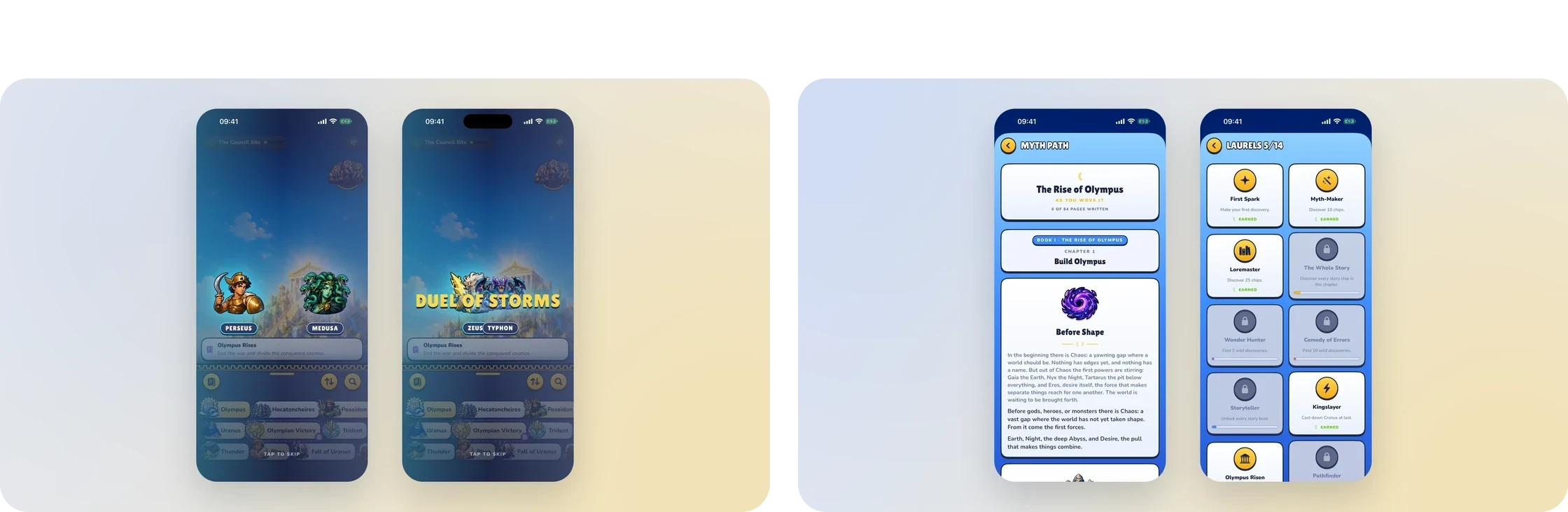
Left Clashes: a face-off, and a title card. Right Retracing the saga: the Myth Path and Laurels.
The Myth Path and map let players retrace the story and see how their discoveries connect across the saga. The first chapter is free and complete, and the rest is sold as permanent book unlocks, matching the book-shaped structure of the story. I’m now refining how the game celebrates major milestones and the end of the full saga, so its final moments feel as considered as the journey to reach them.

A world to play in: the title and a dressed board of heroes.
I also designed and built a website for the game, in the same aesthetic as the game itself, to explain how it works. Its centrepiece is a compact crafting table, so visitors can try the core mechanic in the browser before they play.

Left The landing page hero. Right The Oracle’s Table, a playable version of the crafting mechanic.
Build
Authored rules on native frameworks
MythCraft is a native iOS game built in SwiftUI and SpriteKit, with SwiftData for progress and StoreKit 2 for the free chapter, book unlocks and optional Oracle packs. A deterministic craft engine resolves every combination against authored recipes; nothing about the rules is generated during play. Core Haptics and AVFoundation give discoveries and reveals their feel, and Apple's on-device Foundation Models give the Fates optional short lines in quiet stretches, restating the current scene and nudging the player back towards it, without ever advancing the plot.
SwiftUI
SpriteKit
SwiftData
CloudKit
StoreKit 2
Foundation Models
01
Authored, not generated
Every discovery comes from a designed recipe, so each one is deliberate.
02
Help without spoilers
The Oracle's whispers escalate from a hint to the full recipe, at the player's choice.
03
Tested at scale
Repeatable simulated play across all twelve chapters, checked by a full human playthrough.
Outcome
A four-book saga, playable end to end
MythCraft is in development, with all four books and twelve chapters playable end to end, a free first chapter and permanent book unlocks. My daughter has played the full saga, and repeatable simulated play completes every chapter. The design turns an open-ended combining mechanic into an authored story, with guidance built into the world rather than bolted on. What remains is the finish: how the game celebrates major milestones and the end of the saga.
An authored saga
Four books and twelve chapters of Greek myth, driven by designed combinations.
In-world guidance
Fate's scene-setting and the Oracle's graduated whispers keep players oriented.
Content judgement
AI-assisted research into the myths, shaped and approved by my daughter for tone and age.
A consistent world
An extensive, curated illustration set across characters, scenes and encounters.
Status
In development · TestFlight
In development · TestFlight
Reflection
Guidance works best when it belongs to the world
A hint system bolted on top of a game tells players they're lost. Guidance that belongs to the world, like the Fates setting a scene or the Oracle offering a whisper, keeps them inside the story while it helps. Ideally a product explains itself and needs no guidance at all. Where it can't, because the content asks people to learn as they go, I build the help into the experience and let people choose how much of it they want.


